

by sistemacosmetico
Share
DEBATE ON THE PRIORITIES OF THE COSMETICS INDUSTRY
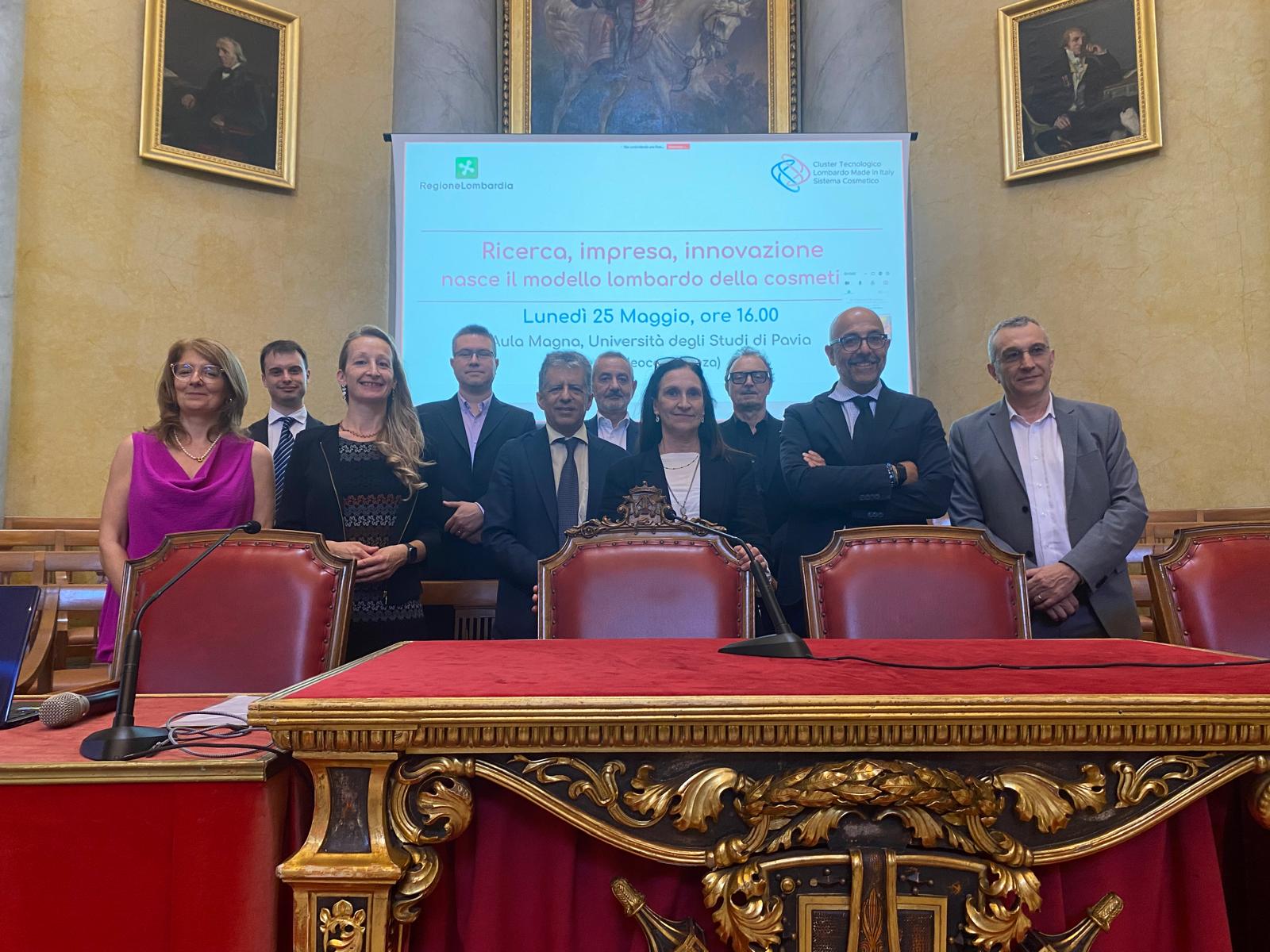
Pavia, 25 May 2026 – Yesterday at 4:00 PM, the public debut of the Lombardy Technology Cluster for Made in Italy – Cosmetic System took place at the Aula Magna of the University of Pavia.
The objective is clear: to integrate scientific expertise, advanced research and industrial capabilities in order to transform innovation into competitive value on European and international markets.
An open ecosystem
The Cluster sends a strong message to Lombardy’s production system: it aims to be a place for open, horizontal and democratic collaboration, where every organisation can find the “extra spark” needed to innovate. Its pre-competitive structure removes barriers linked to company size, allowing SMEs to participate in strategic discussions alongside major industrial players and benefit from a wealth of knowledge that would otherwise be difficult to access.
The event opened with institutional greetings from Federica Villa, Deputy Rector of the University of Pavia, followed by a speech from Tommaso Mazzei, Deputy Director General of the Directorate General for University, Research and Innovation of the Lombardy Region. In addition to congratulating the Cluster on this achievement, Mazzei provided an overview of regional planning and the major reforms currently underway, confirming the central role of Lombardy’s production sectors and the needs represented by Clusters.
Listening to these needs is essential for enabling the regional authority to keep pace with change and transform challenges into opportunities for development and competitive advantage. Mazzei highlighted one of the strengths of the Italian cosmetics sector: its investment in Research and Development, which is twice the national average. He also presented the main regional measures supporting investments in innovation and skills, including the Collabora e Innova call, whose €90 million funding decree will be signed in the coming days.
The inclusive approach of the Cluster was reflected in the contribution of Ilaria Massari, President of the CTL Made in Italy – Cosmetic System, who directly involved both the audience and online participants.
“The Cluster aims to be the link between university research and the market, becoming a place for dialogue and collaboration among its member stakeholders,” stated Ilaria Massari, President of the CTL Made in Italy – Cosmetic System. “The Cluster plays a leading role at international level, together with France, in guiding the network of European cosmetics regions. Already in June, the Cluster will participate in an event in Brussels representing the entire European cosmetics sector.”
Synergy between industry and academia
The synergy between the industrial sector and the academic community emerged clearly during the round tables.
In the first session, company representatives highlighted the challenges facing businesses and how these can be addressed through clusterisation and collaboration with academia. Alessandro Ratini, President of REGI Group, emphasised that building networks among different stakeholders to drive innovation, although not always easy, is an urgent necessity, especially in terms of positioning within the European cosmetics landscape, where the real competitors are certainly not located in Lombardy.
Graziano Fumarola from Ancorotti Cosmetics highlighted how the challenge of sustainable transition is currently perceived across the entire sector, and how collaboration with universities plays a key role in addressing it. In particular, within the Cluster framework, smaller companies will also be able to access sustainability-related knowledge and expertise that would otherwise be difficult to obtain.
Matteo Moretti, President of Lumson, explained that the considerations raised by his fellow speakers regarding products also apply to cosmetic packaging. Today, packaging has evolved beyond its traditional role as a simple “container” and has become an integrated system capable of ensuring proper preservation and product properties, while also acting as a driver of sustainable innovation.
In the second round table, with the participation of Professors Giancarlo Aldini from the University of Milan, Miriam Colombo from the University of Milano-Bicocca, Paola Perugini from the University of Pavia and Luca Fumagalli from Politecnico di Milano, it was highlighted how universities, through their complementary expertise, can further support companies in addressing complex innovation challenges such as sustainability, through coordinated and cluster-based actions.
From vision to action
In conclusion, Daniele Perossa, Manager of the CTL Made in Italy – Cosmetic System, illustrated how the Cluster is already actively developing specific projects to support companies along three main strategic directions:
- advanced digitalisation;
- sustainable and circular transition;
- increasing awareness among Lombardy citizens of the importance of the cosmetics industry and of the outstanding professional opportunities it offers.

